desplazamiento
Over the past few years, I’ve spent time in farming communities across Kenya—walking fields, listening to farmers’ challenges, and seeing firsthand how changes in land management can transform both livelihoods and landscapes. In my role at Boomitra as Executive, Farm Operations in Kenya, I focus on building and scaling soil carbon projects with smallholder farmers across the country. This article draws on that experience, and on what we’re learning alongside thousands of farmers adopting minimum tillage as part of a broader shift toward regenerative agriculture and carbon farming.
Kenya stands at a crossroads where agricultural necessity, climate resilience, and carbon removal ambition converge. For decades, farmers have battled declining soil fertility and rising input costs that have steadily eroded yields and income. At the same time, Kenya’s agricultural sector remains one of the country’s biggest climate vulnerabilities and one of its most powerful climate solutions. Minimum tillage, one of the simplest and lowest-cost regenerative practices, is emerging as a lever that addresses all three challenges at once.
This is not theory. Across Kenya’s drylands, highland farms, and mixed-crop systems, minimum tillage is proving itself as a practical, scalable pathway to restore soils, strengthen rural livelihoods, and remove atmospheric carbon at meaningful scale.
Traditional tilling breaks up soil to prepare fields for planting. But repeated disturbance comes with hidden costs. It releases stored soil carbon into the atmosphere and destabilizes soil structure, leaving land more vulnerable to erosion and less able to retain water. Nutrients are lost more quickly, driving up fertilizer needs, while microbial life and root networks that underpin long-term fertility are disrupted season after season.
I’ve seen this pattern repeatedly while visiting farms across western and eastern Kenya. Fields that are tilled deeply year after year often look clean at planting time, but struggle later in the season, crusting after heavy rains, drying out quickly during dry spells, and producing uneven crops.
Minimum tillage flips this logic. By reducing soil disturbance sometimes by 30%, sometimes by as much as 90%, farmers preserve organic matter, protect soil structure, and allow biological processes to rebuild fertility. Over time, minimum tillage acts like a “soil savings account,” accumulating carbon, moisture, and nutrients that improve productivity while reducing climate risk.

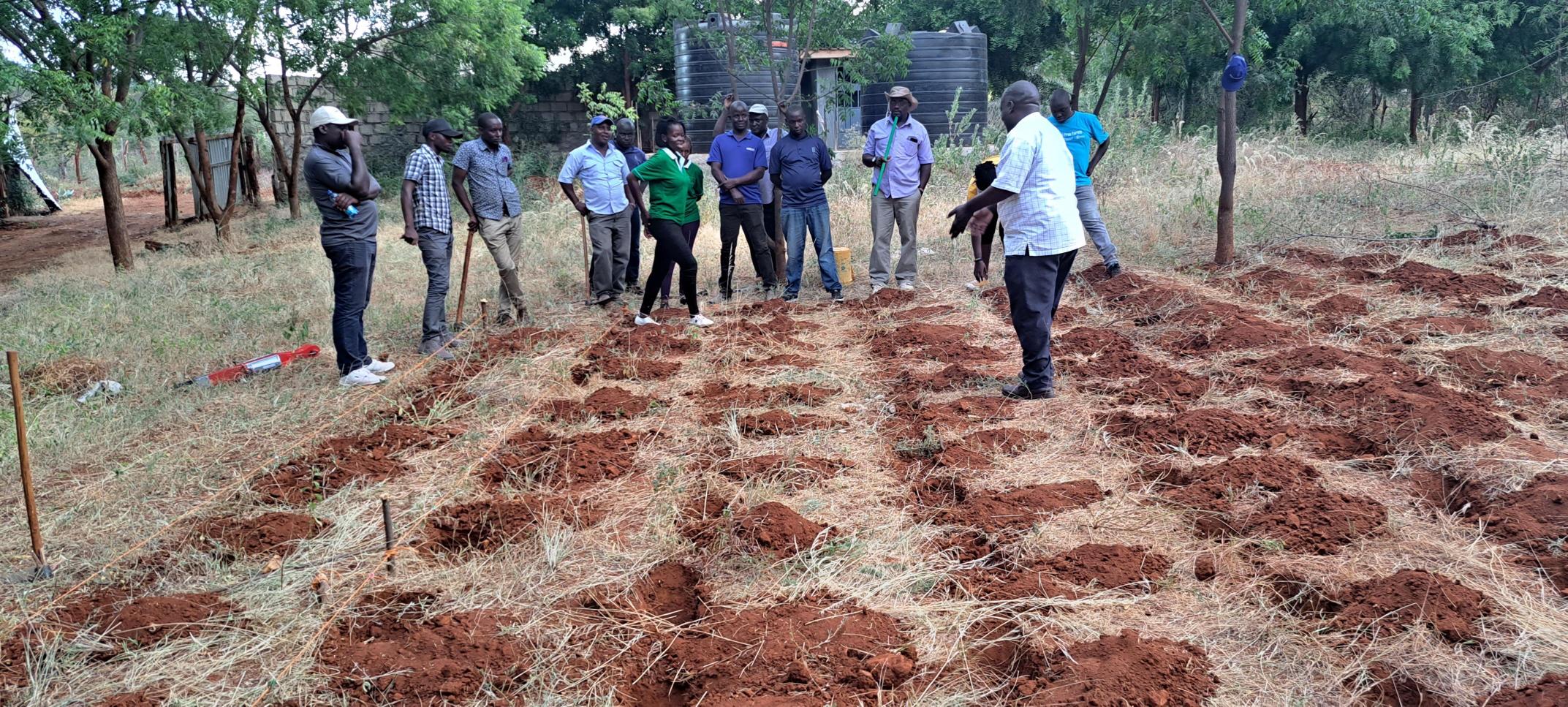
Farmers preparing a field using reduced tillage techniques. I took this photo while working with a farmer group during a field training, where we discussed residue management and why leaving soil covered can make such a difference during dry spells.
Kenya is uniquely positioned to benefit from minimum tillage for three reasons.
Roughly 70–80% of Kenya is arid or semi-arid. In these landscapes, every drop of water counts. Minimum tillage increases soil water retention, reduces evapotranspiration, and helps crops survive mid-season dry spells. In dryland regions such as Tharaka-Nithi County, trials show that minimum tillage can increase soil moisture by 30–35% and significantly improve water-use efficiency compared with conventional tillage.
For farmers in places like Tharaka-Nithi, Narok, and Machakos, this can mean the difference between a harvest and a total loss.
Like much of sub-Saharan Africa, Kenya faces widespread soil degradation. Many croplands have lost a significant share of their original soil organic carbon. Because these soils are far from saturation, they have a large capacity to draw down carbon when management improves.
Global research suggests that switching from conventional to minimum or conservation tillage can increase soil carbon stocks by roughly 0.45–1.8 tonnes of CO₂e per acre per year, particularly in drier regions and during the first years of adoption. With more than 7.5 million smallholder farmers in Kenya, even conservative sequestration rates translate into substantial national-scale potential.
Tillage is labor-intensive and fuel-intensive. Reducing passes over the field lowers fuel use, tractor hire costs, labor requirements, and, over time, fertilizer needs as soils regain fertility. For smallholders operating on thin margins, this is not just an environmental practice—it is a financial one.
Minimum tillage is one of the rare agricultural practices where nearly every outcome is positive: it boosts soil fertility by helping organic matter build over time, reduces erosion during heavy rains, and improves water retention during drought. It also lowers operating costs for farmers by cutting fuel and labor needs, while supporting healthier, more biodiverse soil ecosystems. And because it keeps carbon in the ground rather than releasing it through repeated disturbance, minimum tillage can contribute to carbon sequestration at scale—often alongside higher and more stable yields over time.
Farmers from Nakuru to Meru consistently tell me the same thing: once they adopt minimum tillage and see the results, they do not go back. The soil changes. The crops respond. The land becomes easier and cheaper to manage.
After working with thousands of farmers across Kenya, three things stand out as essential for scaling minimum tillage in Kenya.
First, training and agronomic support. Farmers need localized guidance, not generic advice. Soil types, rainfall patterns, residue availability, and crop systems vary widely across the country, and recommendations must reflect those realities.
Second, access to suitable tools. Simple equipment such as rippers, jab planters, and conservation tillage implements must be affordable and locally available.
Third, carbon finance integration. High-integrity soil carbon programs can provide farmers with an additional revenue stream, making adoption financially attractive even in the first season and rewarding long-term stewardship.
Kenya already has many of the structural advantages needed for success: vast agricultural land, a motivated farming population, and one of Africa’s most dynamic climate-tech ecosystems. What is needed now is scale, coordination, and sustained investment.

The photo shows a farmer using a ripper to prepare land with minimal soil disturbance, opening narrow planting lines instead of turning over the entire field. I took this during a field visit in western Kenya, where farmers showed how reduced tillage helps conserve soil moisture, protect structure, and lower fuel and labor costs. Seeing it in practice makes clear how minimum tillage works as a practical, climate-smart solution rather than a theory.
Boomitra Carbon Farming in East Africa through Soil Enrichment Project is helping turn minimum tillage from a promising idea into a mainstream practice. In Kenya, nearly 3,730 farmers managing more than 68,000 acres of cropland are already enrolled, adopting reduced tillage and other regenerative practices that rebuild soil carbon and improve yields.
Boomitra’s remote sensing and AI system approved under Verra’s VM0042 methodology reduces the need for intensive soil sampling, keeping monitoring costs low and ensuring that most carbon revenue flows back to farmers and their communities. As soil carbon increases, farmers benefit twice: through healthier, more productive land and through carbon income that rewards good stewardship
When I met Joyce Shami in Mumias East earlier this year, she spoke candidly about how uncertain farming used to feel. For many seasons, her maize harvest barely reached seven 90-kg bags. Land preparation costs were rising, soil fertility was declining, and unpredictable rains made every planting decision a risk.
After joining Boomitra’s carbon farming program, Joyce began practicing minimum tillage reducing soil disturbance and leaving crop residues on her field. Over time, she noticed her soils holding more moisture, requiring fewer inputs, and supporting sturdier maize plants that performed better during dry spells.
Within a few seasons, the change was undeniable. Joyce’s maize harvest increased from 7 bags to 22 bags, turning her farm into a far more reliable source of food and income. Minimum tillage has also reduced her labor and fuel costs, and she will soon earn carbon income linked to the additional carbon stored in her soil. For Joyce, minimum tillage is not an abstract climate solution, it is a practical way to manage risk, restore her land, and build a more secure future.

Joyce tending to her corn field in Mumias East.
Minimum tillage may look modest, just a different way of preparing land. But its implications ripple outward.
For Kenya, it supports a more climate-resilient agricultural system.
For farmers, it boosts income and reduces risk.
For the planet, it creates a meaningful carbon sink at a moment when gigaton-scale solutions are urgently needed.
The world is searching for carbon removal solutions that are affordable, scalable, durable, and aligned with human development. Minimum tillage in Kenya is one of them.
Interested in high-integrity soil carbon credits from Kenya? Contact our team to learn more.
Photo credits: Collins Ongu Oranga


EMPRESA
SOLUCIÓN CLIMÁTICA

Al optar por participar, aceptas nuestra Política de privacidad